
Flower Drum Song is not just a musical—it’s part of a much larger story about who gets to be seen, and who gets to belong.
I discovered Flower Drum Song when I was a kid, quite by accident, flipping through channels on a tiny black and white TV. At the first commercial break I ran downstairs to put it on the “big” color TV and scoured the TV listings in the newspaper to find out what this was. “Flower Drum Song (1961)—Rogers and Hammerstein’s musical set in San Francisco’s Chinatown.” For the first time I saw, in glorious Panavision and Technicolor, a depiction of Asian Americans as American—not stereotypes who did martial arts and spoke with accents and were mostly relegated to background characters. As problematic as the story may have been looking back, it was still an important part of how I could see myself as an American.
At the Democracy Center, we believe democracy is not only about voting or civic institutions. It’s about whether people see themselves—and just as importantly, whether others see them—as part of the evolving story of America.
And when that recognition is missing, when communities are erased, simplified, or pushed to the margins, it doesn’t just affect culture. It weakens the fabric of democracy itself.
We are living in a moment where that kind of erasure is not abstract. It’s happening in real time. Histories are being challenged, stories are being excluded, and the question of who “counts” as American is being contested once again.
Institutions like the Japanese American National Museum (JANM) and the Democracy Center have made a clear choice: to stand for visibility, to stand for truth, and to stand for a more expansive understanding of American identity. Last year, JANM’s Board of Trustees published its Statement on the Defense of History, Democracy, and Civil Rights, and JANM’s Chair of the Board of Trustees, William T Fujioka, vowed to #scrubnothing in reference to diversity, equity, and inclusion. This year, the Museum emerges #janmstrong with unprecedented support from the community and is ready to reopen its doors in late 2026. Both Scrub Nothing and JANM Strong T-shirts are available online at the JANM Store.
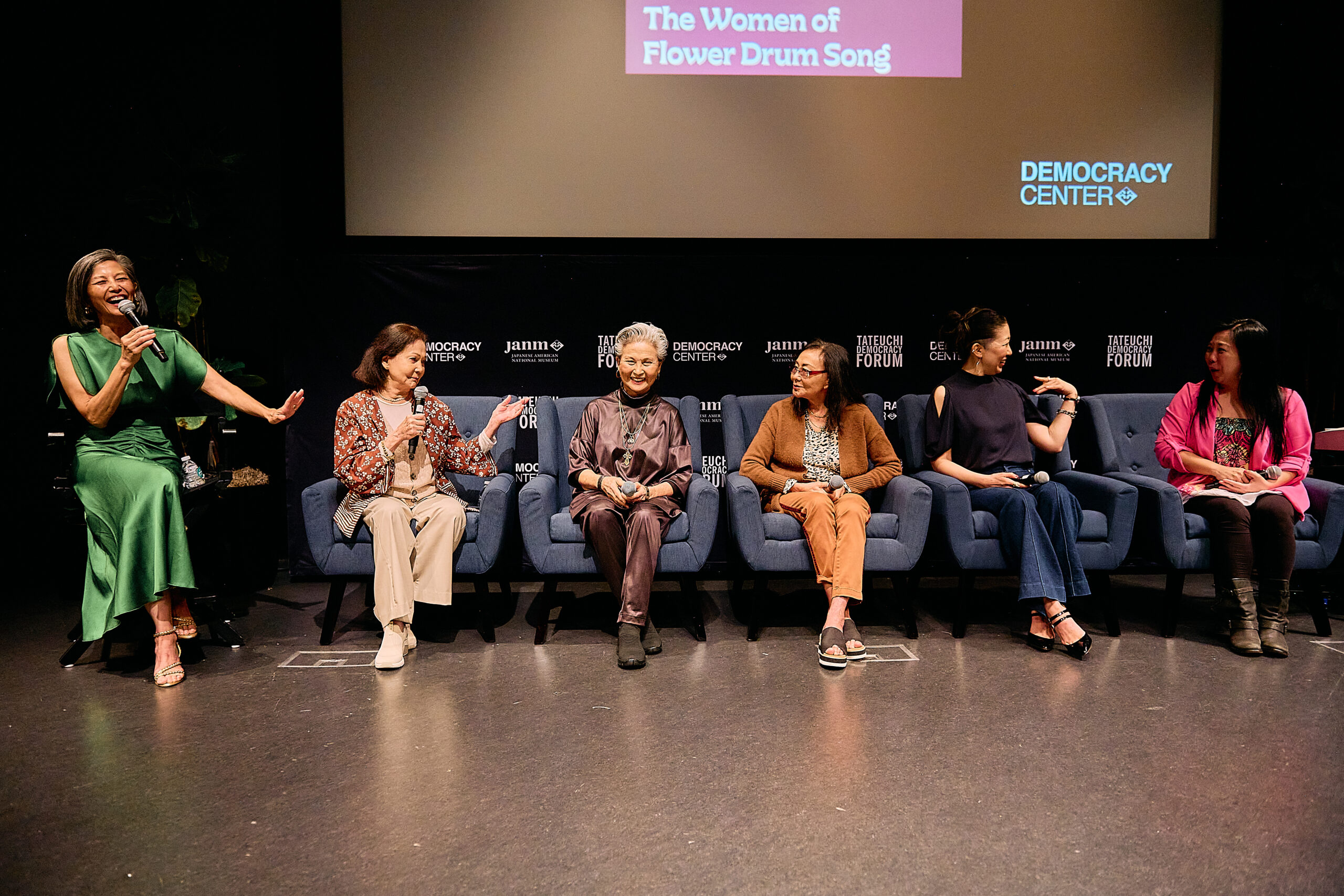
The Women of Flower Drum Song
In March of this year, we welcomed artists who have appeared in many major productions of Flower Drum Song—including among others the original Broadway production, the 1961 motion picture, the 2022 revival, and the 2026 production from East West Players and the Japanese American Cultural and Community Center that opened a few weeks ago.
The Women of Flower Drum Song brought us into conversation with artists who didn’t just perform roles. They had to navigate an industry, and a culture, that often didn’t fully see them for who they were. And yet, through their work, they helped expand what audiences could imagine… and who audiences could accept as belonging.
“We can only do what is new if we honor what is old. Our work is built on the backs of the artists of the last sixty years [since East West Players began] …This our story, our history, our legacy,” said Lily Tung Crystal, the director of Flower Drum Song and the artistic director of East West Players (EWP).
“I found my Asian-ness and pride…I could be proud and happy with being me,” said Lainie Sakakura, who was in the 2002 Broadway revival of the musical.
Their stories remind us that representation is not just symbolic. It’s transformative. Yes it shapes how we see ourselves, but also how we see each other.
And that’s where real change begins.
This is also a story of evolution—of a work of art that has been revisited, reinterpreted, and reclaimed across generations. Each iteration reflects a deeper, more complex, and more honest understanding of identity, culture, and voice. For this 2026 production of Flower Drum Song, playwright David Henry Hwang created a newly updated, “refreshed” book to further revise his 2002 Broadway adaptation. He updated the script to better reflect modern conversations on Asian American identity while maintaining faithfulness to Rodgers & Hammerstein songs.
“Each and every one of us wants to be both [Mei Li and Linda Low] at the same time. That film really encapsulates what it means to be an American woman and lucky enough to have a foot in our mother heritage,” said Tamlyn Tomita, who moderated the conversation.
This evolution mirrors our democracy itself—something that is never finished, but always evolving toward greater inclusion.
The event was not just about looking back at a groundbreaking musical. It was about recognizing the artists who helped move us forward. And about affirming that American culture has always been a mosaic that has been shaped by many voices, many histories, and many perspectives.
“Find yourself. Believe in yourself. It’s tough for Asians to find meaningful roles in Hollywood,” advised Nancy Kwan, the star of the 1961 film adaptation, to the next generation of Asian American actors.
It is also about continuing the work of our nation to ensure that everyone not only sees themselves in that story but is seen by others as fully belonging within it. That recognition, that sense of belonging, and that shared understanding of who we all are is where democracy truly begins and how our democracy will endure.
You can catch Flower Drum Song at EWP now through May 31, 2026. The musical is the grand finale for the theater company’s Diamond Legacy season. Tickets are available at eastwestplayers.org.

Photo by Mike Palma.

Photo by Mike Palma.
Featured photo: Tamlyn Tomita moderates the Democracy Center program, The Women of Flower Drum Song, featuring panelists Nancy Kwan, Helen Funai Erickson, Irene Tsu, Lainie Sakakura, and Yuka Takara. Photo by Mike Palma.
About the Author
James E. Herr is the director of the Daniel K. Inouye National Center for the Preservation of Democracy (Democracy Center), which explores the rights, freedoms, and fragility of democracy, helping to build bridges, and find common ground between people of diverse backgrounds and opinions. The Democracy Center convenes people of all ages and diverse backgrounds to examine issues about race, identity, and social justice to transform attitudes, celebrate culture, and promote civic engagement.