

This blog post was published on the Democracy Center’s Preserving Democracy blog with permission by the California Community Foundation (CCF). The post was originally published on CCF’s website on January 29, 2026.
June 6, 2025; 9:15 a.m. A moment that Angelenos had never before seen. Masked and armed federal agents swooped into the downtown Los Angeles garment district, unleashing tear gas, raiding businesses, arresting workers and injuring protesters – including the respected labor leader David Huerta.
For philanthropist Miguel Santana, activist Angelica Salas and journalist Memo Torres, the federal assaults demanded action – and they leaped into it.
Santana, president and CEO of the California Community Foundation, raised $7 million to assist Angelenos impacted by the raids. Salas, executive director of the Coalition for Humane Immigrant Rights, activated her rapid response network to help those detained and their families. Torres wrote story after story for L.A. TACO – and would start a daily brief chronicling immigration raids and related news.
“Is it a time to hide, or is it a time to become louder?” Santana said he and his fellow philanthropists asked, noting the federal government’s attacks on universities, law firms, cultural institutions and other sites of resistance.
CCF chose to become louder, harnessing the privilege of grantmaking to support those in need, Santana said. “It was, frankly, the day of greatest clarity for me about what our role had to be,” he said.
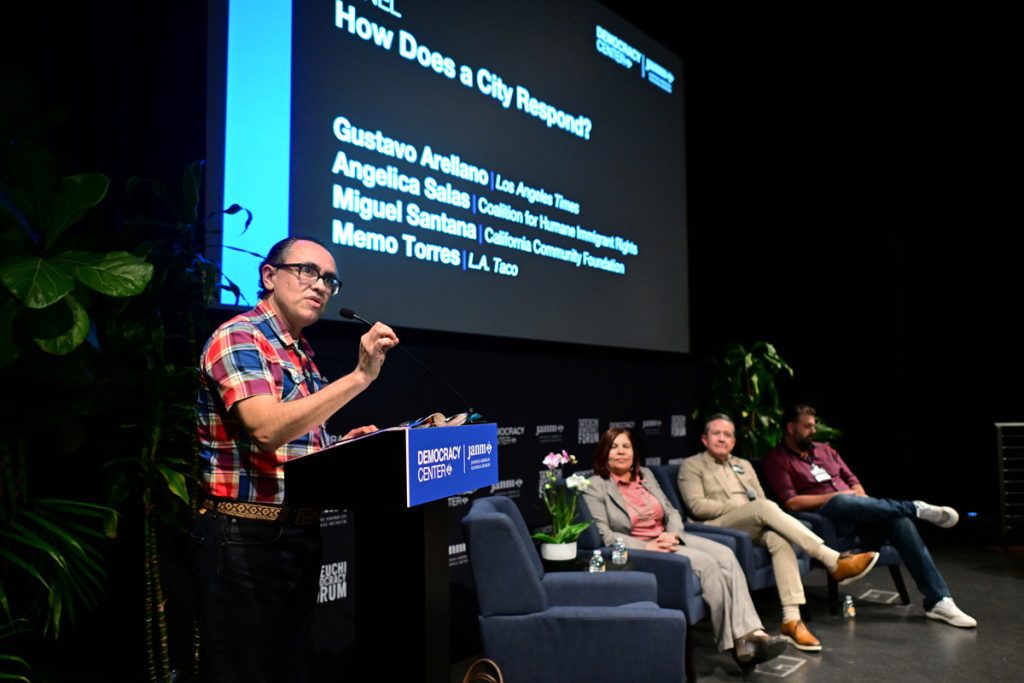
The three changemakers recently shared stories on how they’ve aimed to make a difference in the fight against authoritarian attacks on immigrants and the nation’s civil rights and democratic ideals at a January 23 forum sponsored by the Japanese American National Museum in the Little Tokyo neighborhood of Los Angeles. The daylong symposium – “Echoes of History: Inspiring Civic Action and Building Democracy” – explored the rising wave of global authoritarianism and how to fight it through solidarity and collective action.
In welcome remarks, JANM Board of Trustees Chair William T. Fujioka recounted how Japanese Americans on the West Coast were subjected to mass incarceration in desolate camps ringed by barbed wire in 1942 – after Japan bombed Pearl Harbor – without hearings or evidence of disloyalty. The museum’s mission, he said, is to preserve that history, defend civil rights and stand up for other marginalized communities under attack.

“What happened to my community in 1942 is happening today to immigrant communities throughout the nation,” said Fujioka, whose family was imprisoned in the Heart Mountain incarceration camp in Wyoming. “Very few people stood up for the Japanese American community. This cannot happen again. We will stand up for other marginalized communities and speak to the importance of social justice. We proudly support all immigrant communities because we are children of immigrants. This is a time for all of us to stand together for civil action democracy as one community.”
Agnès Callamard, Amnesty International secretary general, delivered a passionate keynote address urging people to resist what she called the historical destruction of international human rights values and principles created on the ashes of the Holocaust and the massive deaths during World War II.
“Now is not the time to appease. Now is not the time to capitulate,” she said in a video address from London. “There has never been a more important moment to resist, to disrupt, to stand up and to say no.”
The move toward global authoritarianism began many years ago, with the silencing of dissent and freedom of expression, extraterritorial killings and arrests of hundreds of human rights defenders, she said. Those forces have been accelerated by the current U.S. administration, she said – but added that they have been overturned in countries around the world through collective action by people with courage and persuasive demands for justice.
“And if you remain in any doubt, then recall the West African proverb: If you think you’re too small to make a difference, try spending the night in a tent with a mosquito,” Callamard said.
In other panels, activists outlined the playbook for authoritarians and successful ways to fight them. Robert Evans, an internet broadcaster, journalist and author who reports on global conflicts and online extremism, said general strikes are one of the most powerful tools of resistance but need union support to be most effective.
He spoke in conversation with JANM President and CEO Ann Burroughs, who said mass mobilization broke the back of apartheid in her native South Africa – where she was imprisoned for protesting against the racist regime. Mass protests, consumer boycotts and external pressure were key tools that overturned apartheid, she said.
Scot Nakagawa, co-director of the 22nd Century Initiative, a national strategy and action center focused on resisting authoritarianism and building a more democratic future, said despots use the same tactics: mass operations against scapegoated communities. Emergency powers to justify mass violations of civil rights. Institutional purging of those deemed disloyal. Criminalizing dissent. The collapse of the rule of law to rein in abuses.

But several tools of resistance have proven successful, he said: recruiting defectors from pillars of support for authoritarianism, such as the military, business, churches. Sustained non-cooperation, such as slow-walking regime orders. Building coalitions that transcend ideology. Centering the leadership of women, whom Nakagawa said tend to be more disciplined in maintaining non-violent approaches. Using humor to deflate the authoritarian power image – such as Portland’s protestors donning inflatable frog costumes to face off against federal immigration agents.
“Never, ever underestimate the power that we have collectively and that each have individually,” Nakagawa said.
Other speakers highlighted the critical role of art and culture in protest movements.
In the session on how cities are responding to the current crisis, moderator Gustavo Arellano of the Los Angeles Times asked panelists what they wanted Angelenos to do.
Salas asked people to take action in any number of ways: join a neighborhood rapid response network to support those harmed by immigration raids. Donate to an immigrant-rights organization. Contact your elected representatives to demand action against the ongoing civil rights abuses and for the legalization of 13 million undocumented people who remain subject to terror.
Torres said he hoped people would realize the raids are still happening and destroying families. “I am so tired of constantly being the loud voice in a small room that nobody really hears,” he said. “Outside, there’s so many people that think that this is not happening nowadays. It’s affecting our neighbors and the brown folks but really the intention is to eventually take everyone’s rights away.”
Santana said Angelenos should respond because the fight involves far more than immigrants.
“Immigrants are being used as a scapegoat to erode core American values, norms and institutions,” he said. “And what’s happening to immigrants will happen to you. So every person needs to fight for these core American values, and it should be in every way that you can.”
– Teresa Watanabe
