
On Monday, February 23, guests gathered at the Herald Examiner Building in downtown Los Angeles for a conversation with three museum leaders about censorship in the field, the power of trust that museums hold, and the need to act together to usher in transformation. Zócalo, the Japanese American National Museum (JANM), and the Museum of Contemporary Art (MOCA) partnered on the program, How Do Museums Resist Censorship?, which also expanded on the themes of the Democracy Center’s symposium, Echoes of History: Inspiring Civic Action and Building Democracy.
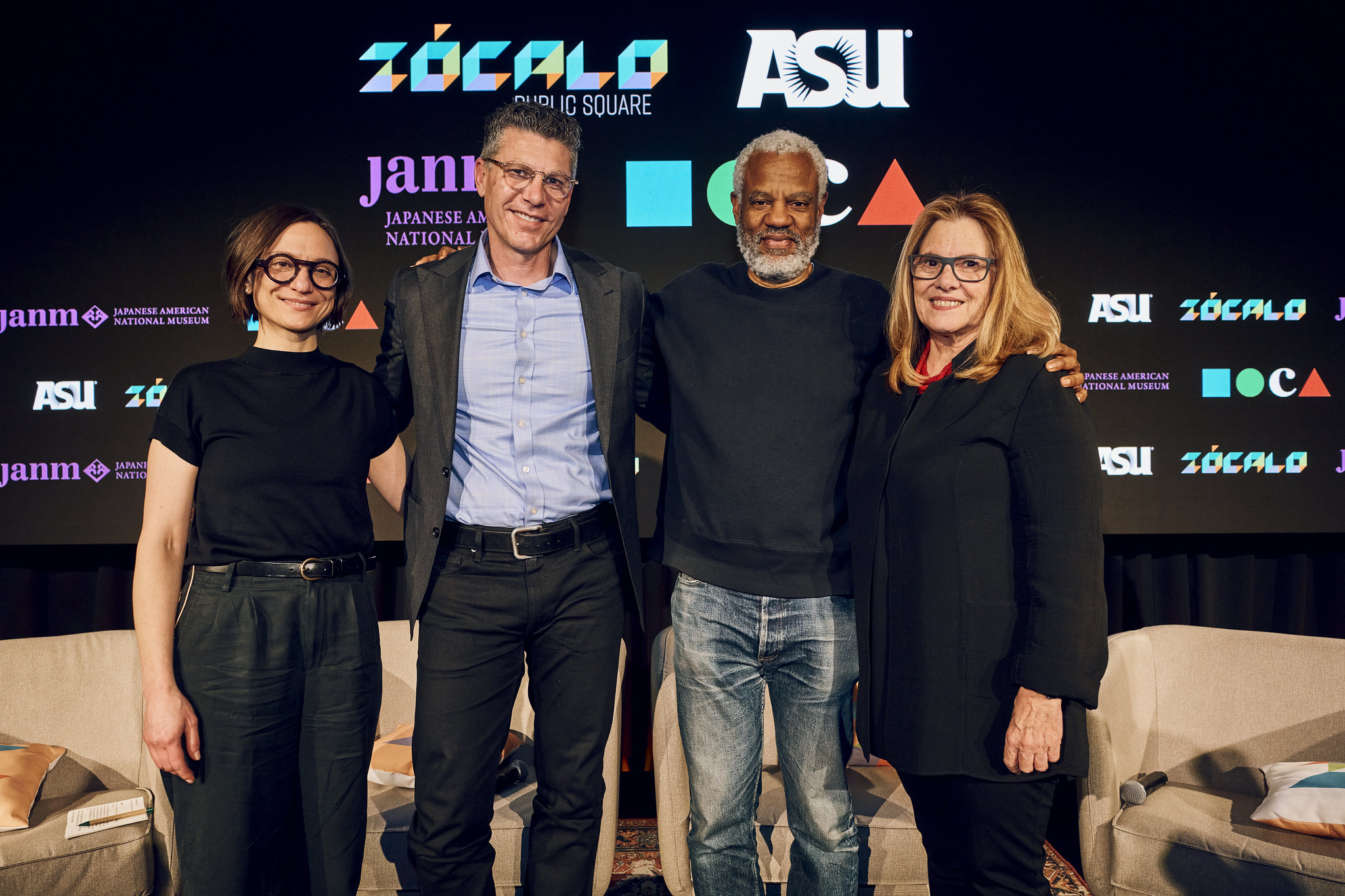
Elizabeth Larison moderated the panel with Devon Akmon, Ann Burroughs, and Hamza Walker. Larison is the director of the National Coalition Against Censorship’s Arts & Culture Advocacy Program, which protects artistic freedom in the US. Akmon is the chair of the American Alliance of Museums and the director of the Michigan State University Museum; Burroughs in the president and CEO of JANM, and Walker is the director of The Brick and co-curator of MONUMENTS. Larison kicked off the discussion by asking the panelists how their institutions or the museum field interprets or internalizes political pressures.
“Where we are today, I believe, is we are facing a direct attack on the institutions themselves with the funding and everything that permeates. And frankly, I think the field and a lot of our peers are unsettled and do not know how to respond to that and are trying to do that in real time,” said Akmon.
Burroughs expanded upon Akmon’s remarks by stating “It’s this incredibly deep attempt to homogenize culture—homogenize culture and to erase history because…we know that those are some of the most vibrant things in any kind of resistance playbook and certainly we see ourselves as being part of that ecosystem.”
Walker clarified the pressures of censorship and their affect on the field by acknowledging “that pressure produces a kind of conscious—degrees of conscious or unconscious—becoming conflict averse. Not really wanting to, when that pressure is applied—push comes to shove, push comes to love—stand up.”
They described their institutions’ resistance to censorship from various forces today and expanded upon Larison’s questions that included: What is at stake in compliance or resistance? How does the museum field reckon with those risks, and what are they doing publically or quietly? What is the value of museums’ work during this moment?
“One of the wonderful things about museums is we remain among the most trusted institutions in our nation. We have an imperative to stay true to our values and the work we do,” said Akmon. “I think right now you’re starting to see museums and libraries and all types of other institutions saying, ‘How do we do this together? We have more muscle together. We’re stronger together. And we are so foundational to civic society and democracy. We must do this together.’”
Burroughs told the story of how JANM was the first museum in the US to make a statement in defense of civil rights, history, and democracy. The statement was personal for the museum’s Board of Trustees because their families were unjustly incarcerated during World War II. It was a statement of defense and defiance that wielded memory as power, not as nostalgia or remembrance.
“I think about memory as power because memory determines who are the holders of history, whose stories are going to be told, who’s going to tell those stories. And there’s enormous power in that. And there’s also enormous power in shaping what the future is going to be. That’s a power that we can’t afford to give up, and that’s a power that is absolutely under attack.”
Walker talked about how not knowing what power structures would be at play when MONUMENTS opened allowed the exhibition to develop complexities and layers of its own.
“It’s about figuring out what it is that you believe in and what you think is important to say, and then to continue the work needed to do that. And to find the resources and to trust an artist and what it is that they want to do.”
Featured Image: Elizabeth Larison, Devon Akmon, Hamza Walker, and Ann Burroughs. Photo courtesy of Mario de Lopez.
Watch the Full Program
Go Behind the Scenes with the Panelists
Devon Akmon: Our Communities Are Not a Monolith
Ann Burroughs: People Make Me Hopeful
Elizabeth Larison: Consistency and Dedication Can Get You Results
Hamza Walker: Professionally I Grew Up in the Art Institute of Chicago
What’s Next?
On Sunday, March 29, 2026, the Democracy Center presents the public program, The Women of Flower Drum Song. Performers from across the musical’s history will come together for a conversation exploring how representation in the arts expands the understanding of belonging, strengthens civic identity, and is a strong reminder that American culture is built from many cultures. Tickets are $20 ($5 for JANM Members and students) Follow this link for more details, and we’ll see you there!