
As we prepare to celebrate Independence Day for the 250th time, the Democracy Center’s Sofia Alvarez reflects on the activities for the 2026 Civic Season—the season between Juneteenth and July 4th.
More than a Game: Baseball and Japanese American History at Far Bar
Baseball is one of the magnetic sports that has fans getting excited this season. Every summer, Little Tokyo welcomes visitors from all over the world to experience the incredible food and culture of the historic neighborhood. Today, as visitors drive down 1st Street into Little Tokyo, they are greeted by the 150-foot mural of Japanese baseball star Shohei Ohtani along the east facing side of the Miyako Hotel.
According to Adam Burke, the president of the Los Angeles Tourism Board, Japanese tourism to Los Angeles has seen a 90% increase since 2022. After joining the Dodgers in 2023, Ohtani has had an immense impact both on and off the field. Local restaurants and businesses have seen a huge boost in business from visitors who have traveled overseas and those who have driven from just two hours away.
For a neighborhood that was named one of the most endangered historic places in the country by the National Trust for Historic Preservation in 2024, the influx of support and the resiliency of the community has strengthened Little Tokyo.
What many of these visitors may not know is that baseball has always been a part of the Japanese American experience. It represents something far bigger than just a game. Baseball has been a source of resilience and hope during some of the nation’s most challenging chapters.

On June 19, 2026, the Democracy Center at JANM invited guests to Far Bar in Little Tokyo to enjoy pre-game vibes while exploring the powerful role baseball has played in Japanese American history. The evening featured a presentation by Kristen Hayashi, JANM’s Director of Collections Management & Access and Curator, who shared real stories from the JANM collections about how the community preserved culture, built solidarity, and maintained hope during periods of hardship. Photographs of America’s concentration camps, including a recorded account of the camp league experience, serve as a lasting reminder of how the sport of baseball has become an act of belonging.
The process of arranging the baseball trivia for the event taught me a lot about how diverse the world of baseball really is. Learning about incredible stories of Bob Gibson and his induction to the Baseball Hall of Fame or how Melvin Mora collected four extra-base hits in a single game showed me that there is no single way to be American in an “all American sport”.
As someone who never grew up with major team sports, it is moving to see the ways communities across the US celebrate these traditions. But living in Los Angeles, it is almost impossible to not be within a five-mile radius of an arena or sporting event. So you can only imagine the sheer awe of seeing Canada, Mexico, and the United States be the hosts for the 2026 FIFA World Cup. The outpouring of unity and pride has reminded me of the innumerable ways in which sport unites and uplifts communities—especially immigrant communities.
Within us all, there is the innate yearning for a sense of belonging. The more I’ve spoken with sports fans, the more I’ve learned that perhaps we have more in common than I ever imagined. Soccer matches, baseball games, and even Civic Season pre-game events remind us that American history lives not just in the confines of textbooks or museum galleries but also in the stories we share, in the traditions we celebrate, and in the communities we build. Sometimes all it takes is a conversation, a shared meal, and the love of the game to bring history to life.
Reimagining the American Flag through Art: Unseen Territories Film Screening and Community Workshop
What does the American flag mean today? For some, it represents freedom and opportunity. For others, it evokes complex histories of exclusion, resistance and identity. As we near the 250th anniversary of the signing of the Declaration of Independence, the most common iconography we can expect to see is the American flag. But during such a monumental moment in American history, many have been left reevaluating what this icon means to them. This Civic Season, we explored what it means to reflect on America’s past while actively shaping how we see the future through artistry and community building.
Unseen Territories is an award-winning documentary in which fourteen fourteen BIPOC artists challenge and reimagine the flag and other symbols, creating work that asserts identity, memory, and presence. On Saturday June 27, the Democracy Center hosted a screening of Unseen Territories followed by a conversation with filmmaker Sydney Galindo and featured artist Jesus Orozco. Together, they shared insights into the creative process and how this project has helped foster dialogue around art and its ties to historical narratives.

In preparation for the event, Sydney and I spoke candidly about the panel questions. As a moderator, I was perhaps too held up on the ways such a public symbol could challenge us as opposed to unite us. Sydney challenged me to look past the iconography and current polarization of a flag. She didn’t want the symbolism of a flag to polarize Americans but rather to unify them. Sydney emphasized that this “country is big enough for all of us” and that the intent of this project was never to erase the American flag but instead to expand the meaning of what an American flag could be.
Rather than presenting a single representation of patriotism, Unseen Territories explored multiple perspectives and encouraged viewers to examine how symbols evolve alongside the communities that they represent. When we closed out the panel session, Sydney shared that they intend to bring this project to Los Angeles to work with local artists in representing their own interpretation of the flag.
In such a diverse city, it excites me to think about all the ways Angelenos already express themselves when they feel like they belong in America. By encouraging our community to question familiar symbols and imagine a more inclusive future, this Civic Season event demonstrated how museum spaces can serve as welcoming spaces for reflection and dialogue about American identity and its future.
JANM’s Wish Wall at The Huntington’s THIS LAND IS … Community Festival
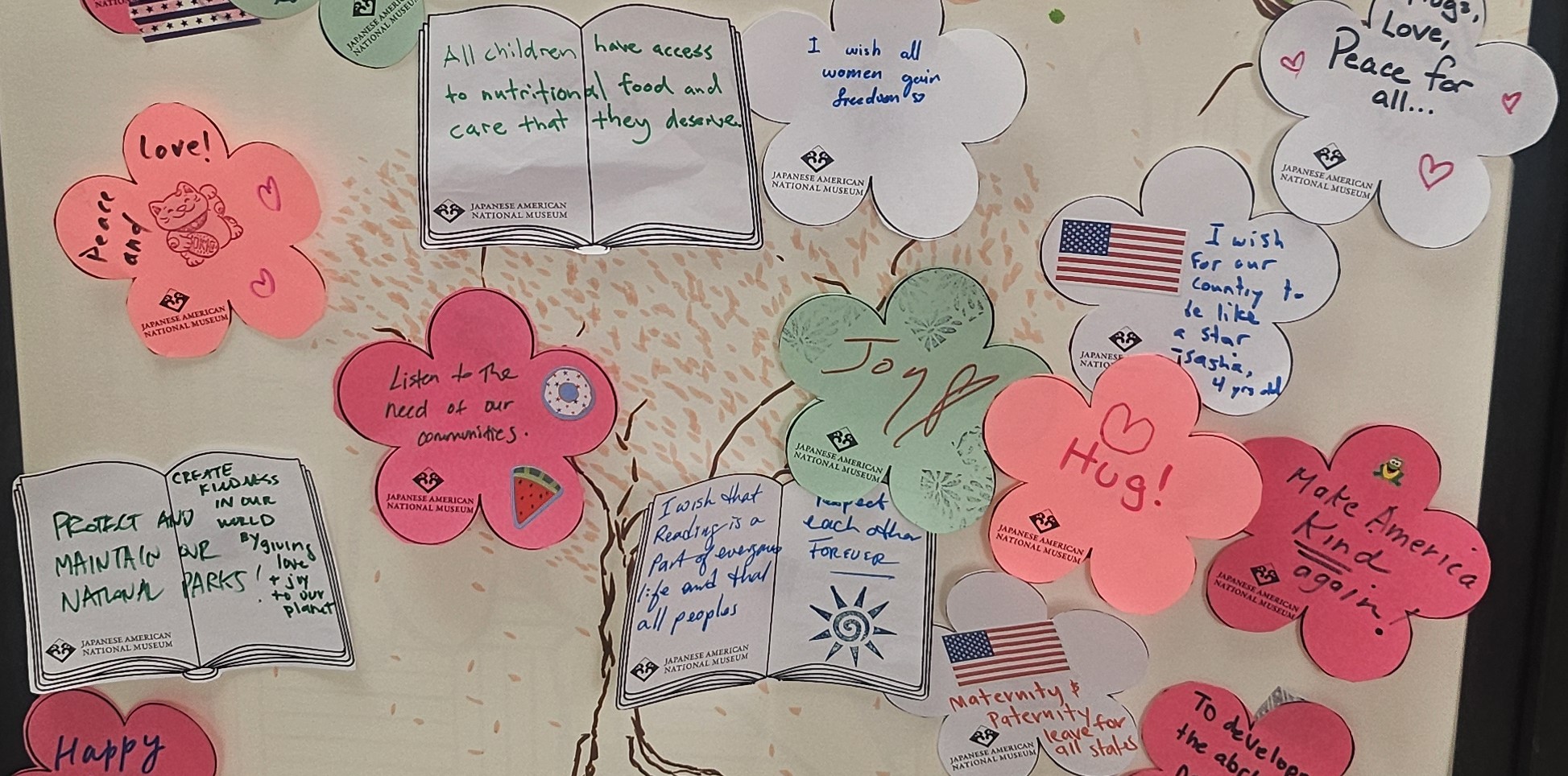
The Democracy Center was recently invited to participate in The Huntington’s THIS LAND IS … Community Festival. In celebration of the 250th anniversary, the Huntington launched “THIS LAND IS… a sweeping multiyear initiative that invites visitors to reflect on the American story through the lens of land.” Sunday was another successful stop on the Democracy Center’s Wish Wall tour, led by one of JANM’s local high school volunteers.
The Wish Wall activations are something I’ve really come to enjoy. It’s given me the opportunity to speak with other young people in the community about their direct role in this democracy. When we first started hosting this activation at JANM in late 2025, the question “What is your wish for America?” was met with intrigue and curiosity. Over the course of the last six months, that question has at times been met with unease and even suspicion. But some of the most fruitful conversations have been with folks who are a bit hesitant to answer that question on paper. As I asked Gen Z or Gen Alpha people walking past us with their parents trailing several feet behind, I found that many would pause or sit to reflect on their answer before sharing a thoughtful wish on the flower shaped cutouts. Seeing groups of young people engage with a question like this and walk off to enjoy the rest of their day in the gardens was a promising reminder that autonomy and a safe space give way for growth and independence.
As we’ve continued to bring the Wish Wall to new spaces, I’ve realized how important these third spaces are to the people exploring them. A GenZ educator shared that they love coming to explore the Huntington in depth because he doesn’t always get to take his time through all the exhibitions when they bring their students guided tours during the school year. Another guest, a parent of two middle schoolers busy at work on their Civic friendship bracelets, told me how important it was for her to take her children to see the rare copies of the Declaration of Independence. For those who were not as familiar with the 250th anniversary, it was a great conversation starter into their personal views about civic engagement.
Every flower added to the wall represents a unique perspective. They remind us that democracy is built not only through elections and civic institutions, but also through the voices, values, and dreams of everyday people. These Wish Wall activations are more than just collecting reflections on a board but also sparks conversations with visitors about what it means to be civically engaged. This continued invitation to imagine the future contributes to a larger story about who we are as a nation, who we aspire to become, and how we take part in building that future together.